Tell us about the job
Takes about a minute. No obligation.
A heat pump running a full heating season in New York County puts sustained stress on the refrigerant circuit, the reversing valve, and the compressor in ways that a short idle period never fully offsets. Homes in New York County, NY run heat about seven months a year, from October through April. By late winter, the compressor has been cycling against cold outdoor air since October, and a contractor diagnosing a fault here checks refrigerant charge and valve function before assuming a part simply aged out. Wear on those components is cumulative, and what a technician opens up often reflects months of hard thermal demand rather than a single failure event.
Ductwork laid down for an earlier generation of heating technology carries air differently than what a heat pump expects, and those mismatches show up as wear patterns inside the unit itself. Half the homes in New York County, New York were built in 1951 or earlier (2020-2024 ACS 5-year). Stock that old was ducted for something else first, and whatever adaptations followed left behind pressure profiles and airflow characteristics that a heat pump runs against every cycle. When a contractor opens the equipment to diagnose a fault, the compressor and coil surfaces carry a record of that history. Parts that fail in a system running in adapted ductwork fail differently than the same parts in a clean installation, which changes what the repair actually requires.
The Parts of a Heat Pump a Contractor Checks First
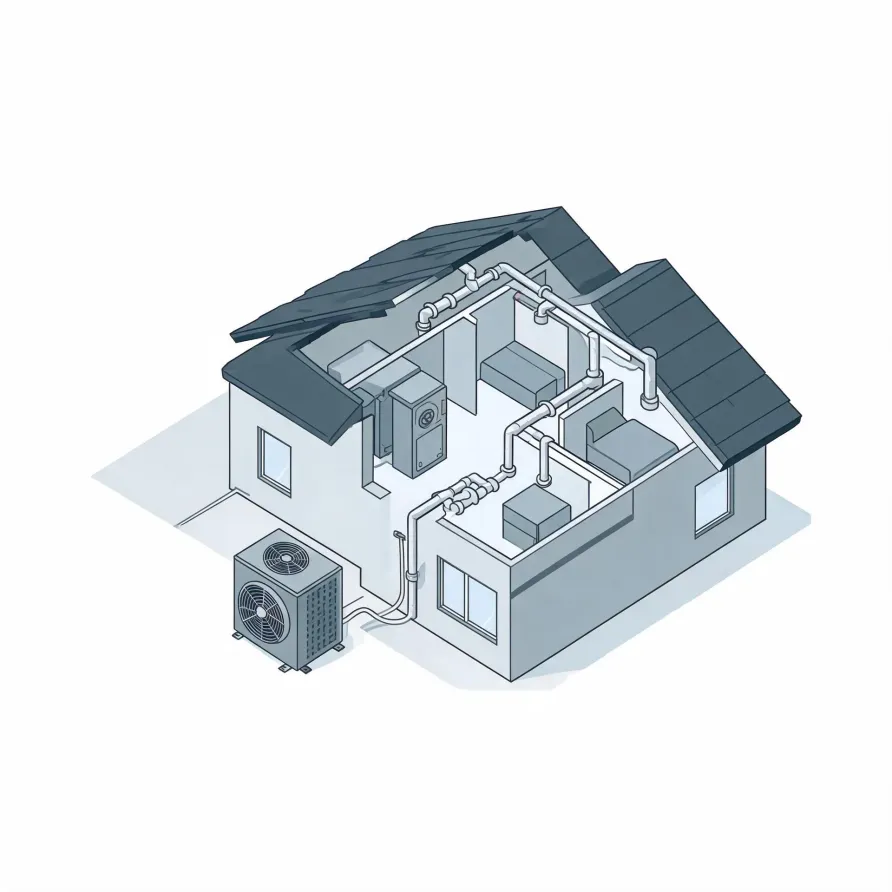
The outdoor unit sits on a pad beside the house and holds the compressor, the reversing valve, and the outdoor coil. The compressor is the piece contractors reach for first when a heat pump stops moving heat. The reversing valve is what lets the system heat in winter and cool in summer, and a stuck or leaking valve is a common reason a system gets stuck in one mode.
The air handler sits inside the house, usually in a closet, basement, or utility room, and pushes conditioned air through the home. It holds the indoor coil and the blower motor, both of which a contractor examines when airflow drops or the system runs but does nothing useful. The refrigerant lines connect the two units, and a contractor checks them for leaks whenever the system is low on charge.
The drawing shows a typical layout, and a licensed contractor determines which parts apply to your specific setup.
Get matched in New York CountyNew York County, by the numbers
52 severe weather events were recorded in New York County, New York between 2015 and 2024.
NOAA National Centers for Environmental Information, Storm Events Database, bulk CSV export, events 2015-01-01 through 2024-12-31.Half the homes in New York County, New York were built in 1951 or earlier (2020-2024 ACS 5-year).
U.S. Census Bureau, 2020-2024 American Community Survey 5-Year EstimatesNew York County, New York holds 923,472 housing units (2020-2024 ACS 5-year).
U.S. Census Bureau, 2020-2024 American Community Survey 5-Year EstimatesOwners occupy 25.1% of the occupied homes in New York County, New York (2020-2024 ACS 5-year).
U.S. Census Bureau, 2020-2024 American Community Survey 5-Year EstimatesWeather Events in New York County That Stress HVAC Systems
Extreme weather puts heat pumps under load at exactly the moments they are least likely to get a break. How often that happens in your area shapes how hard the equipment works and how quickly small faults become failures.
52 severe weather events, 2015–2024. Source: NOAA National Centers for Environmental Information, Storm Events Database.