Tell us about the job
Takes about a minute. No obligation.
A contractor quoting a heat pump installation in Yates County has to work out what the unit will actually deliver on the coldest days of the season, not just what it delivers on a mild October afternoon. Homes in Yates County, NY run heat about eight months a year, from October through May. As outdoor temperatures fall toward their winter lows, a heat pump's output falls with them, which means a system sized to the seasonal average will run short of capacity when the house needs it most. The installer has to establish the design heating load at the low end of the local temperature range and decide where backup resistance heat enters, before any equipment gets selected.
Ductwork laid down for an older furnace or central air unit carries assumptions about static pressure, return sizing, and airflow that do not transfer cleanly to a heat pump. Half the homes in Yates County, New York were built in 1969 or earlier (2020-2024 ACS 5-year). That depth of housing stock means a contractor opening up a Yates County home for a heat pump install is frequently looking at ducts that were never designed for the delivery profile the new system needs. Whether the existing runs can carry it, or whether sections have to be rebalanced or replaced, is what actually sets the scope and the price of the job.
What Gets Installed With a New Heat Pump
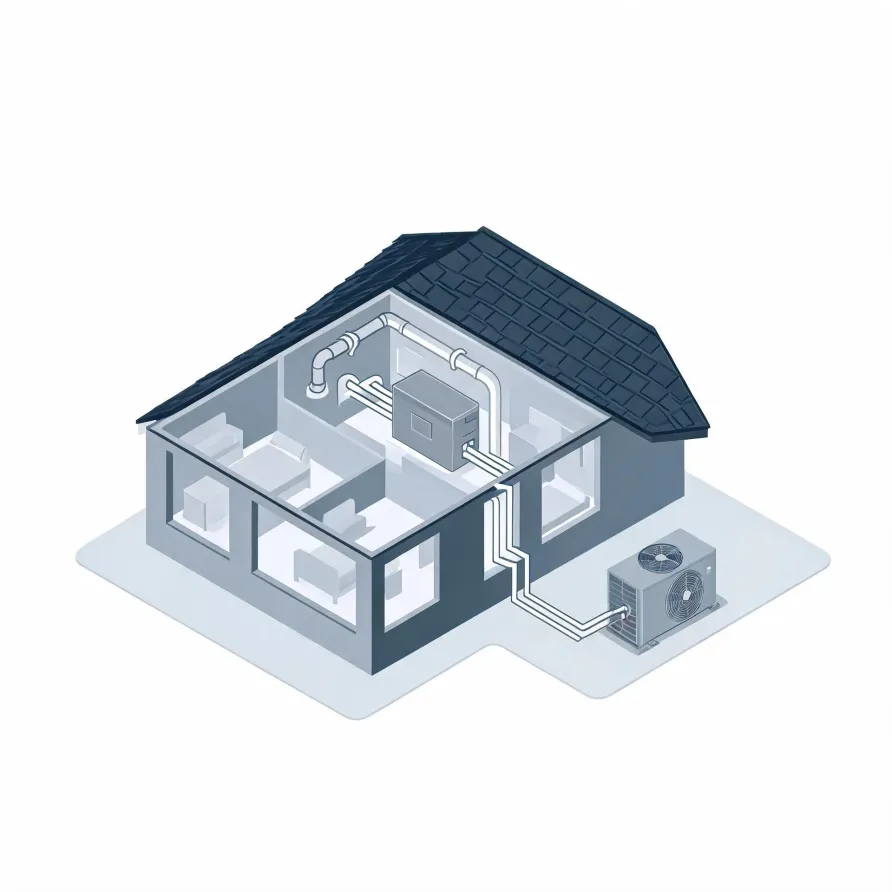
The outdoor unit is the piece a homeowner sees first, mounted on a pad or brackets outside the house, and it holds the compressor and the main coil that does the work of moving heat in and out. Inside, the air handler sits in a utility space, closet, or attic and pushes conditioned air through the home.
A refrigerant line set runs between the two units, connecting them through a small penetration in the wall. The thermostat goes on an interior wall and gives the homeowner control over the whole system. A condensate drain line runs from the air handler to carry off moisture.
The drawing shows a typical layout, and a licensed contractor determines exactly how each piece fits the conditions of your house.
Get matched in Yates CountyYates County, by the numbers
73 severe weather events were recorded in Yates County, New York between 2015 and 2024.
NOAA National Centers for Environmental Information, Storm Events Database, bulk CSV export, events 2015-01-01 through 2024-12-31.Half the homes in Yates County, New York were built in 1969 or earlier (2020-2024 ACS 5-year).
U.S. Census Bureau, 2020-2024 American Community Survey 5-Year EstimatesYates County, New York holds 13,211 housing units (2020-2024 ACS 5-year).
U.S. Census Bureau, 2020-2024 American Community Survey 5-Year EstimatesOwners occupy 77.2% of the occupied homes in Yates County, New York (2020-2024 ACS 5-year).
U.S. Census Bureau, 2020-2024 American Community Survey 5-Year EstimatesSevere Weather Events in Yates County
Weather in this part of New York puts real demands on heating and cooling equipment over its lifetime. A heat pump sized and installed for local conditions handles that load better than one that was not.
73 severe weather events, 2015–2024. Source: NOAA National Centers for Environmental Information, Storm Events Database.