Tell us about the job
Takes about a minute. No obligation.
Sizing a heat pump for this county is a local calculation, not a catalog lookup. Homes in Cattaraugus County, NY run heat about nine months a year, from September through May. Heat pump capacity drops as outdoor temperatures fall, and in a climate that pushes through a full heating season, a system that looks adequate on paper can spend the coldest weeks leaning on its backup heat strip to close the gap. A contractor working an install here has to run a load calculation against actual outdoor design temperatures, then confirm the backup element is sized to cover what the refrigerant cycle cannot. Get that wrong and the homeowner carries it in their electric bill every January.
Ductwork laid out for a furnace follows a logic that does not always translate to a heat pump, which moves air at lower temperatures and higher volumes. Half the homes in Cattaraugus County, New York were built in 1960 or earlier (2020-2024 ACS 5-year). That vintage of construction means a contractor's first question is what the existing duct system can actually carry, not which unit to order. If the runs are undersized or the returns too few, the equipment choice matters less than what surrounds it.
What Gets Installed With a New Heat Pump
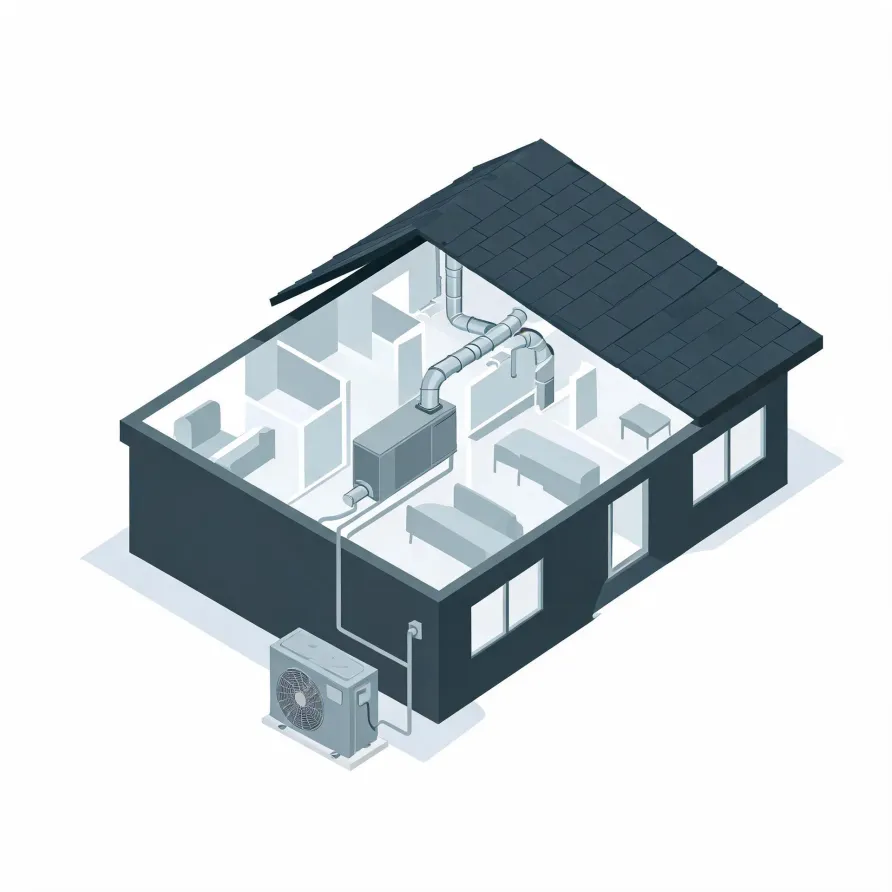
The outdoor unit is the piece a homeowner sees first, mounted on a pad or bracket outside the house, and it holds the compressor and the condenser coil that do the primary work of the system. Inside, an air handler sits in a mechanical room, basement, or closet and circulates conditioned air through the home.
A refrigerant line set runs between the outdoor and indoor units, carrying the working fluid through copper tubing that gets routed along the exterior wall or through a chase. A thermostat goes on an interior wall and gives the homeowner control over the whole system.
The drawing shows a typical layout, and a licensed contractor determines exactly how each piece is positioned and connected in your home.
Get matched in Cattaraugus CountyCattaraugus County, by the numbers
247 severe weather events were recorded in Cattaraugus County, New York between 2015 and 2024.
NOAA National Centers for Environmental Information, Storm Events Database, bulk CSV export, events 2015-01-01 through 2024-12-31.Half the homes in Cattaraugus County, New York were built in 1960 or earlier (2020-2024 ACS 5-year).
U.S. Census Bureau, 2020-2024 American Community Survey 5-Year EstimatesCattaraugus County, New York holds 40,356 housing units (2020-2024 ACS 5-year).
U.S. Census Bureau, 2020-2024 American Community Survey 5-Year EstimatesOwners occupy 75.2% of the occupied homes in Cattaraugus County, New York (2020-2024 ACS 5-year).
U.S. Census Bureau, 2020-2024 American Community Survey 5-Year EstimatesSevere Weather Events in Cattaraugus County
Weather puts a measurable load on heating and cooling equipment, and that load varies by where you live. A heat pump sized and installed for what Cattaraugus County actually sees will perform differently from one built for somewhere else.
247 severe weather events, 2015–2024. Source: NOAA National Centers for Environmental Information, Storm Events Database.